Citizen Use of Pollution Reporter Leads to Accountability and Fines

Grant Buckner • April 25, 2023

Thanks to concerned citizens utilizing our Pollution Reporter Tool, Catawba Riverkeeper was able to track a spill and follow up with regulators.
There are many different ways to be involved with Catawba Riverkeeper that can help benefit water quality. Involvement can range from donating resources to volunteering your time and energy on cleanups to coming out to one of our retail locations and showing your financial support. 


Did you know that another impactful way is to use the Pollution Reporter tool to share concerns you may have? You can report issues you see on either on our website or on the Catawba Riverkeeper App for Android or Apple!


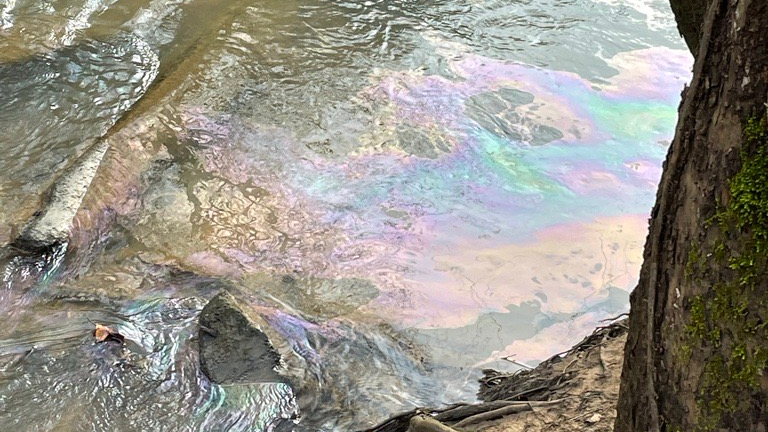
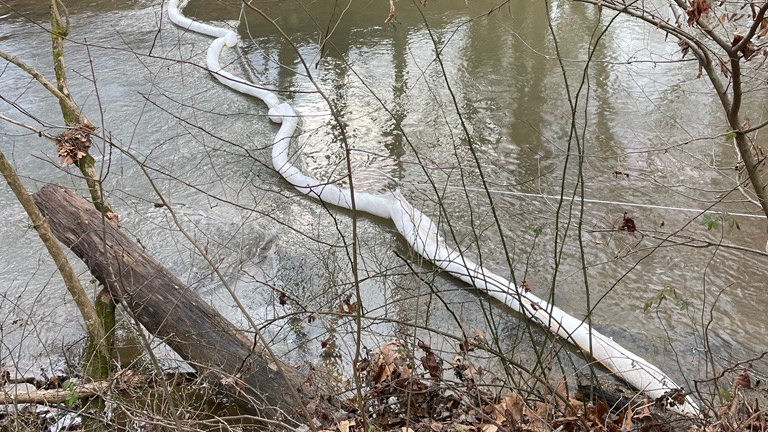
Recently, multiple concerned citizens used the Pollution Reporter tool to help resolve a hydraulic oil spill on the Catawba River. Thanks to concerned citizens, Catawba Riverkeeper received reports just after New Year's Day about an oily substance floating down the Catawba River near Morganton. Within a matter of hours, we were able to visit the site and follow the discharge upstream to Silver Creek, a tributary of the Catawba River. After following the spill until it was not possible to go any further upstream, a spill boom (temporary floating barriers used to contain spills) was noticed to be stretched across the river, indicating someone knew of the spill and was actively trying to collect leaked material. 


After notifying the North Carolina Department of Environmental Quality (NCDEQ) we were able to learn that SGL Carbon in Morganton had suffered a hydraulic leak due to a frozen pipe during the cold snap at the end of 2022, resulting in an illicit discharge and thereby violating their National Pollutant Discharge Elimination System (NPDES) permit. Over the next several days we continued to communicate with NCDEQ to learn more about the spill and to monitor the river for impacts. We were able to notify the public of the ongoing issue and recommend not recreating in that section of the Catawba until the spill was resolved. 


After following up with NCDEQ, we later learned that between December 30th and January 4th approximately 75 gallons of hydraulic oil reached Silver Creek and the Catawba River. Following up with NCDEQ were able to confirm that a fine of over $8,000 had been administered and subsequently paid due to the violation.


Thanks to the involvement of concerned citizens reporting what they saw through our Pollution Reporter tool, we were able to successfully track the spill and follow up with the regulators to ensure the issues were not only corrected, but that action was taken to prevent spills in the future. 


It may seem like a small thing to file a report on an app, but it takes everyone doing their part to make a big difference! Our Pollution Reporter tool is just one more way that you can get involved with Catawba Riverkeeper to help protect clean water for all! 

By Madison Washington June 11, 2026
Native to South America, alligator weed has become a widespread invasive species along the East Coast, rapidly spreading through waterways, wetlands, and shorelines. Its aggressive growth disrupts ecosystems by outcompeting native vegetation, reducing habitat quality for wildlife, and creating challenges for recreation, water management, and local communities.
May 27, 2026
On the evening of May 26th, 2026, Catawba Riverkeeper Brandon Jones attended the Charlotte City Council Public Meeting. At this meeting, he shared our organization's comments on the proposed 150-day data center moratorium. These comments can be read below. "The Catawba Riverkeeper Foundation is a member-funded environmental nonprofit that educates, advocates, and protects the Catawba-Wateree River and all its tributaries. Our organization represents over 8,000 active members and nearly 3 million citizens who rely on the watershed for drinking water, recreation, and electricity. We are concerned that the growth of local data centers may overallocate our limited resources and decrease our ability to respond to drought. We appreciate the opportunity to comment on the proposed 150-day moratorium and strongly support the staff's recommendation to adopt it. Additionally, if adopted, we recommend that the study consider a tiered approach, transparency, and net water consumption. For our water resources, the most important data center metric is net water use. A 400 MW facility—like the one now under construction on Moores Chapel Road—may actually evaporate more water indirectly than directly for cooling. The nearby Catawba Nuclear Station uses approximately 30 MGD to produce 2,300 MW or 5.2 MGD from Lake Wylie per 400 MW. However, without transparency and reporting, it is difficult to know the current impact of these data centers and almost impossible to accurately forecast the industry's future. The most accurate forecast of our region's water resources is the Catawba Wateree Water Management Group’s 2026 Integrated Water Resources Plan. Unfortunately, this plan explicitly does not include increases in water use from data centers due to limited reliable information. It is absolutely critical that our community has accurate information. We need full transparency on the planned electrical and water use of large data centers. A ban of nondisclosure agreements between elected officials and developers could help alleviate suspicion and allow communities to make informed decisions about tradeoffs. The potential direct and indirect impact s of a project should be modeled by the CWWMG to determine its actual impacts. Those impacts could be mitigated by funding water conservation projects, as some data centers have already proposed. Once operating, we need reporting on the actual water and energy use. The cumulative impact must be understood to ensure capacity and resiliency. Water withdrawers from the Catawba utilize a Low Inflow Protocol during drought to help stretch the available supply. Large data centers need conservation plans that comply with this plan. It is hypocritical to ask residents and some businesses to restrict water use while permitting facilities that cannot or will not do the same. Most years, there is plenty of water for drinking, irrigation, ecological flows, and industry in the Catawba. However, droughts such as 2001, 2007, and today expose our vulnerabilities. These droughts are more likely in a warming climate, and we are becoming less resilient with a growing population and industrial demands. Sustainable water management requires careful planning and robust coordination between users, including data centers."
By Susannah Bryant March 19, 2026
Greg Nance has had his boots on the ground since the storm subsided.